Your parent is medically stable. The doctors say there is nothing more the hospital can do for them. But they cannot safely go back to living alone, and the long-term care home your family chose has a waitlist that could run months or years.
So they wait. In a hospital bed. And then, often without much warning, a placement coordinator tells your family that a bed has come available somewhere else. Somewhere you did not choose. Somewhere that may be far from home, or that you have never seen.
If this is where your family is right now, you are not alone, and you are not imagining the pressure you feel. Ontario has specific rules governing this situation, and most families learn about them the hard way, in the middle of a crisis. This article explains what those rules are, what they mean in practice, and what options families actually have.
What ALC Means
When a person occupies a hospital bed but a clinician has determined they no longer need hospital level care, they are given a designation called ALC, which stands for alternate level of care. It is a clinical and administrative label, not a judgment about the person.
ALC patients are often older adults who are recovering from a fall, a stroke, surgery, or a period of decline, and who need ongoing daily support but not acute medical treatment. Many are waiting for a long-term care bed. Some are waiting for home supports to be arranged. Some are waiting because their family is not yet sure what comes next.
It is a common situation. At various points there have been well over two thousand people in Ontario hospitals carrying this designation while waiting for a long-term care placement.
What Ontario’s Rules Say
In 2022 Ontario passed legislation known as Bill 7, the More Beds, Better Care Act, with the stated aim of freeing up hospital capacity by moving ALC patients into long-term care more quickly.
Under this framework, a placement coordinator can carry out certain steps in the long-term care admission process, including assessing eligibility and selecting a home, without the patient’s consent, provided reasonable efforts have been made to obtain that consent first. In practice this means a family may be told a bed has been assigned at a home they did not select.
There is also a financial element. If a patient has been formally discharged and chooses to remain in hospital beyond twenty four hours, the hospital is required to charge four hundred dollars for each additional day. Over a month that is roughly twelve thousand dollars.
These rules have been challenged in court and upheld. Whatever one thinks of the policy, it is the current reality that Ontario families are navigating.
| The pressure most families feel is not imagined. But being told to accept a bed is not the same as having no other options. |
The Option Many Families Are Not Told About
When a family is presented with this situation, the conversation usually gets framed as a choice between two things: accept the long-term care bed being offered, or stay in hospital and absorb the daily charge.
There is frequently a third option, and it is one that families are not always walked through: bringing your parent home with professional support in place.
The daily hospital charge applies to remaining in a hospital bed after discharge. It does not apply to someone who has gone home. And going home does not typically mean giving up a place in the long-term care system. Families can generally remain on the waitlists for their preferred homes while their parent is living at home, though every situation differs and this should always be confirmed directly with the placement coordinator handling the file.
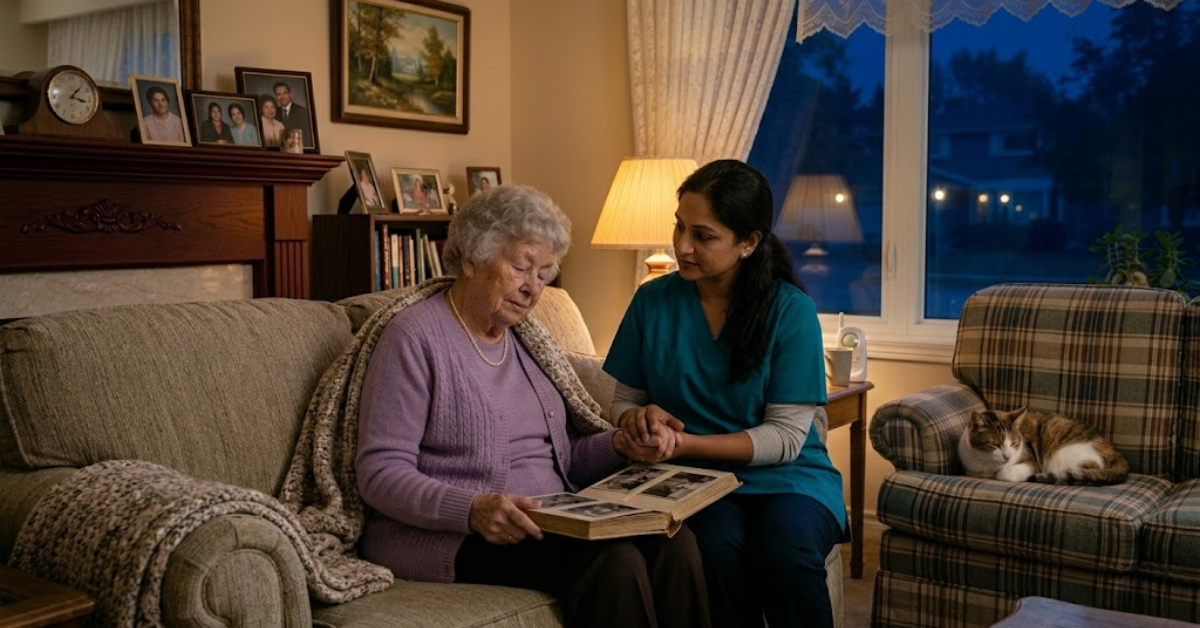
For some families this is the answer. A parent goes home, receives professional care each day, remains in familiar surroundings, and waits for the right home rather than the first available one.
For other families it is not realistic. Some care needs genuinely exceed what can be safely delivered at home. That is an honest assessment that has to be made case by case, with clear eyes.
How to Know If Home Is Realistic
The question is not whether your parent is independent. If they were, this conversation would not be happening. The question is whether the gap between what they can do and what they need can be filled by professional support.
Broadly speaking, home is often workable when the needs centre on:
- Help with bathing, dressing, grooming and toileting
- Medication reminders and routine monitoring
- Meal preparation and nutrition
- Mobility assistance and fall prevention
- Supervision and companionship through the day
- Overnight presence or continuous 24/7 care where needed
Home tends to be more difficult when there are complex ongoing medical interventions, unpredictable behaviours that create a safety risk, or a home environment that cannot be adapted. A proper in home assessment is the only reliable way to know which side of that line a family falls on.
Questions Worth Asking the Hospital Team
If your family is in this position, these questions are worth asking directly and getting answers to in writing where possible.
- Has my parent formally been designated ALC, and has a discharge order been issued?
- Which long term care homes has my parent been placed on the waitlist for, and where do they sit on each list?
- If we take my parent home, do they remain on those waitlists?
- What home care supports can be arranged through Ontario Health atHome, how much do they cover, and how quickly?
- What specific care needs would have to be met for a discharge home to be considered safe?
That last question matters most. Once you know what the care requirements actually are, you can find out whether they can be met.
Where First Class Home Care Fits
We have supported families across the GTA through exactly this decision. When a family is trying to work out whether home is realistic, we come out and assess the situation honestly, including telling families when we think home is not the right answer.
One of our owners personally conducts every initial consultation. Not a coordinator, not a sales representative. Someone who has seen this situation many times and can give you a straight answer about what care would be required and what it would cost.
Our caregivers include PSWs, Social Service Workers, and Nursing Certified personnel, with non-medical oversight from our Personal Care Managers, and we provide everything from a few hours of daily support through to full 24/7 care. We serve Mississauga, Oakville, Milton, Etobicoke West, Burlington, Guelph, Elora and Fergus.
If your family is facing this decision and needs to understand the options quickly, call us at 905-636-9995 or toll-free at 1-855-636-9995, or email info@firstclasshomecareinc.com for a FREE consultation.
You may have more options than you have been told. It is worth finding out before you decide.